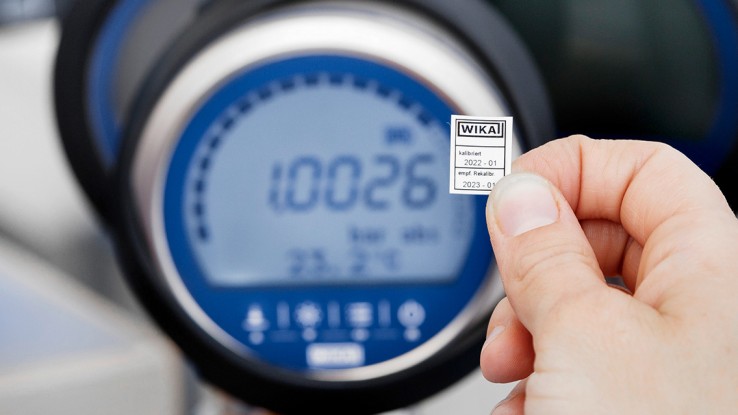
Temperature gauges by WIKA
WIKA is a leading manufacturer of gauge thermometers and machine glass thermometers for industrial and process applications, from HVAC and refrigeration to pharmaceuticals and oil & gas. Robust and reliable, our temperature gauges – including sanitary thermometers with hygienic designs – offer accurate readings and years of dependable service. They are available in a variety of materials, sizes, mounting configurations, stem lengths, measuring ranges, measured values, and with or without probes; several also offer options for switching, capillaries, and output signals.
What’s more, many of our industrial temperature gauges are produced in the Atlanta metro area, so customers are assured of industry-leading workmanship, competitive pricing, responsive customer service, and fast delivery times.
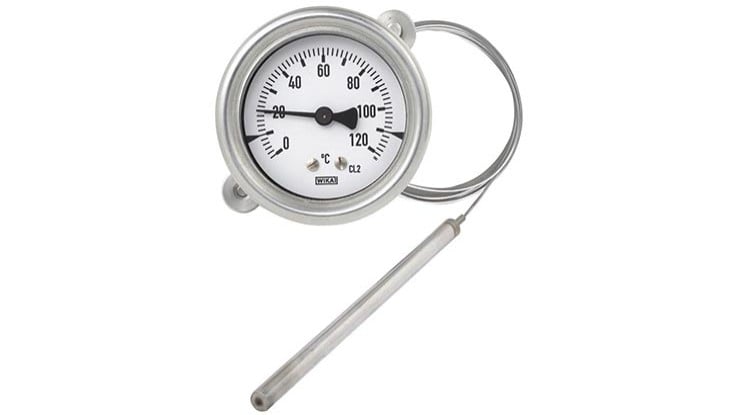
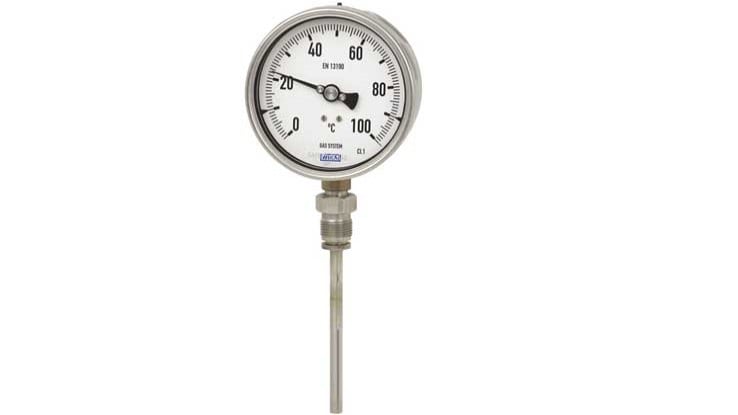
See below for our portfolio of a bimetal temperature gauges, gas-actuated temperature gauges, and expansion temperature gauges.


How is a sanitary thermometer different from a standard temperature gauge?
The main difference between sanitary thermometers and standard versions is that the former is designed to withstand the high heat, high pressure, and caustic chemicals of CIP/SIP (clean in place / sterilize in place). Located on pipelines, bioreactors, fermenters, and mobile vessels, sanitary thermometers offer these advantages:
• Made of stainless steel for corrosion resistance
• High overtemperature resistance – important for applications requiring SIP
• Aseptic process connections to eliminate the dead spaces that harbor bacteria
• Designs that meet 3-A and other sanitary standards
When should an application use a mechanical temperature gauge rather than an electronic temperature sensor?
Temperature gauges like bimetal thermometers and gas-actuated thermometers are for local indication of the process temperature; a person needs to be physically present to read the display. Because it is a simple mechanical instrument, a temperature gauge is typically less expensive, more robust (especially with liquid case filling), easier to install and maintain, and longer lasting than an electronic sensor, which has wiring and requires a power source. In fact, for applications like mobile vessels, a mechanical temperature probe is the most viable option.
WIKA’s Twin-Temp offers the best of both worlds for stationary equipment. This family of temperature gauges with probe, like the TT.32 and TT.50, have two measuring elements: bimetal for the mechanical indication, and either a thermocouple (Types J, K, E, T) or a Pt100 resistance thermometer for electronic data transmission.
What is the difference between expansion thermometers and gas-actuated thermometers?
Both expansion thermometers and gas-actuated thermometers are based on the principle of a fluid acting upon a Bourdon tube. As the fluid expands or contracts within the tube, it moves the pointer. The fill fluid in an expansion thermometer is xylol or silicone oil, while for gas-actuated thermometers it is helium or another inert gas.
What are advantages of choosing stainless steel for an industrial temperature gauge?
When an instrument comes into contact with just hot or cold air, as is the case with many HVAC applications, a thermometer can be made of aluminum or thermoplastic plastic. However, when the media or environment is aggressive, corrosive, or abrasive, a stainless steel case is the safer choice and well worth the slightly higher cost.
An industrial-grade alloy like 316L is the recommended material for sanitary applications, as corroded parts can lead to leaks and contamination. An electropolished stainless steel surface offers even greater cleanability, as it is free of the microscopic peaks and valleys that contribute to corrosion, cracks, and deposits.
When should a probe temperature gauge be used with thermowell?
The job of a thermowell is to shield a temperature probe from direct contact harsh media, such as is found in many oil & gas and chemical/petrochemical applications. The protective tube also protects the sensitive probe tip from high temperatures, high pressures, and high-velocity fluids – in the latter case, the thermowell should have helical strakes to break the vortices that cause mechanical fatigue and premature instrument failure.
Besides protection, thermowells allow technicians to inspect, calibrate, and replace probe thermometers without interrupting the process.
How do I choose the right thermometer for my industrial application?
Keep these criteria in mind when selecting a temperature gauge or glass thermometer (machine-glass thermometer):
• Response time – A gas-actuated thermometer reacts three times as quickly to temperature changes as a bimetal thermometer. Note that if a probe thermometer is inserted into a thermowell, the response time will increase.
• Process temperature – Bimetal thermometers typically has a scale range from −94°F (−70°C) to 1,112°F (600°C). With case filling to protect the measuring element from high shock and vibration, the upper limit drops to 482°F (250°C). Gas-actuated thermometers have wider range, measuring process temperatures from −325°F (−200°C) to 1,292°F (700°C). However, they are influenced by the ambient temperature.
• Vibration – A machine-glass thermometer, like model 32, is impervious to vibration and shock as its only moving “part” is a nontoxic thermometric liquid. And since there is no mechanical wear and tear, glass thermometers enjoy a very long service life and are highly accurate.
• Location and accessibility – When an application calls for onsite temperature readings but is far away or in a hard-to-reach location, a good solution is to pair the temperature gauge with a remote capillary. In such cases, only a gas-actuated thermometer can be used. Some versions have a capillary and another functionality, like the 70-8xx with up to two adjustable micro switches.
With an abundance of choices in the marketplace, it can be difficult to find the right temperature measuring instrument for your specific application. Contact the temperature experts at WIKA USA for personalized assistance and recommendations.

What is the maximum capillary length for gas-actuated and expansion thermometers?
The capillary of a gas-actuated thermometer can be up to ~330 feet (100 meters) long. However, to operate within class 1 accuracy, a large probe volume is needed. With expansion thermometers, the maximum capillary length is 15 meters; otherwise, th ...
more