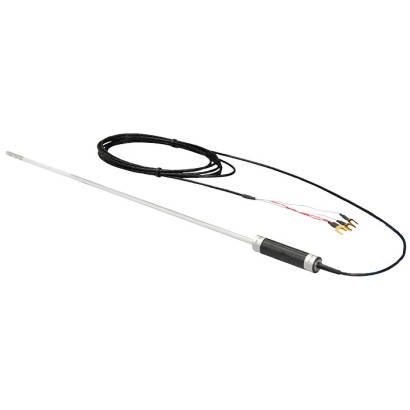
Standard platinum resistance thermometer (SPRT)
Applications
- Reference thermometer for very accurate temperature measurements in a range of -200 … +670 °C [-328 ... +1,238 °F]
- Precision standard platinum resistance thermometer (SPRT) designed to realise the international temperature scale ITS-90 over the range -200 … +670 °C [-328 ... +1,238 °F]
- Comparative calibration in tube furnaces and liquid baths
Special features
- Resistance at 0 °C (R(TPW)): 25 Ω ±0.5 Ω
- R(Ga)/R(TPW): Ratio not less than 1.11807
- Reproducibility: ±1 mK
- Self-heating: ±2 ... ±3 mK with 1 mA and the thermometer in unstirred water
Description
The model CTP5000-R25 standard platinum resistance thermometer (with model Tinsley 5187SA design) is the result of many years’ practical experience and cooperation with the National Physical Laboratory, Teddington, UK, where primary resistance and thermometry standards are maintained.
This four-terminal standard platinum resistance thermometer (SPRT) is designed to realise, with the highest accuracy, the International Temperature Scale ITS-90 over the range -196 … +660 °C [-321 ... +1,220 °F] and is suitable for ITS-90 calibration up to a maximum temperature of 660.323 °C [1,220.581 °F] (aluminium freezing point).
The resistance element is of pure platinum coiled and mounted in a strain-free construction. The former is of fused silica and great care is taken to ensure freedom from contamination.
All the joints are welded, the four leads from the element to the seal in the thermometer head are heavier gauge platinum, thereby avoiding the generation of thermal electromotive forces (EMF) at the junction with the element.
The leads are brought through a hermetic seal at the head of the thermometer and joined via low-loss terminals to copper flex in a specially constructed cable with four conductors. The cable is made with PTFE insulation to ensure low dielectric loss so that the thermometer may be used with either DC or AC measuring systems.
The terminations are gold-plated copper spade lugs. The thermometer tube is specially treated to avoid radiation loss by the piping effect in its walls. Each thermometer is supplied with a purpose-made carrying case.